


Guide: How to choose the right paragliding rescue parachute
A paragliding rescue parachute is your last line of defense in a critical situation. This makes it all the more important that this system deploys reliably in an emergency , opens quickly, and brings you safely to the ground. Nevertheless, the selection of the right rescue parachute is often underestimated or reduced solely to weight and price. In this detailed guide, you will learn which criteria are really decisive, what technical differences there are, and how to find the right rescue device for you.
Why the right choice is vital
Unlike the paraglider itself, a rescue device is rarely used. That is precisely why it must work without hesitation, without thinking, and without surprises. Any delay in deployment, any instability, or excessive sink rate can have serious consequences. Modern rescue devices now offer significantly more safety than previous generations—provided they are correctly selected, properly packed, and compatible with your harness.
Differences in rescue parachute designs
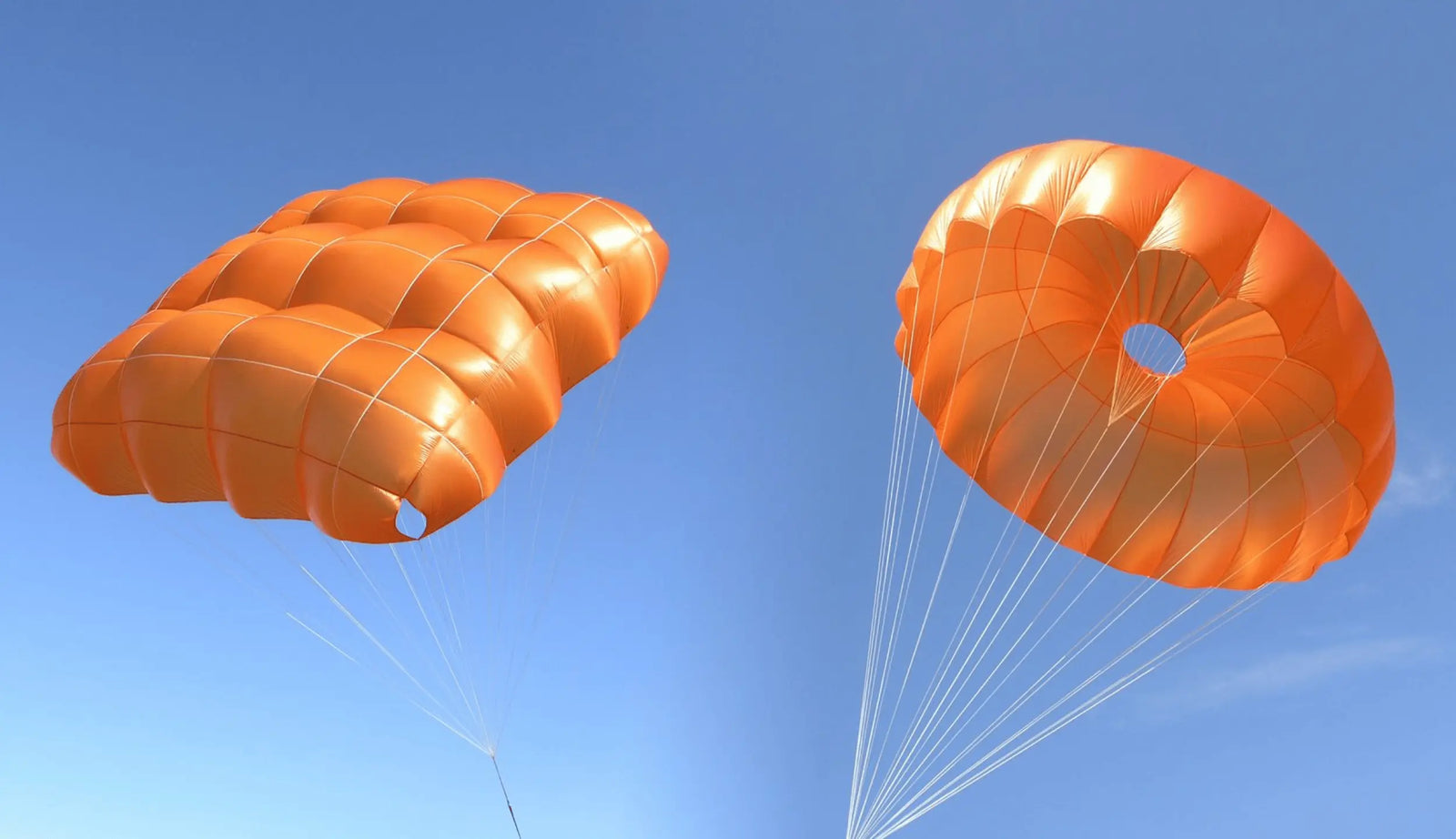
- Round canopy rescue parachutes are simple in design, very reliable, and easy to pack. They open stably, but offer little pendulum stability and no control options.
- Cross-cap parachutes have better pendulum stability and usually a defined lateral drift, which makes the descent calmer and more controlled.
- Non-steerable rescue parachutes function completely passively and are particularly fault-tolerant.
- Steerable rescue parachutes allow for limited directional changes and targeted landing selection.
- Rogallo parachutes resemble a wing and offer active control and forward travel, but require more pilot experience and attention.
Comparison table: Parachute designs at a glance
| Design | Opening | Pendulum stability | Controllability | Sink rate | Advantages | Disadvantages | Suitable for |
|---|---|---|---|---|---|---|---|
| Round cap | Fast | Medium | No | Medium | Simple design, very reliable, easy to pack | More pendulum flying, no choice of direction | Beginners, training, recreational pilots |
| Modified round canopy | Very fast | Average to good | No | Average | Improved stability through valves or slots | Still no control | Beginners and advanced users |
| Cross cap | Very fast | High | No | Low | High pendulum stability, defined drift, smooth descent | Somewhat more difficult to pack | Thermal, cross-country, and safety pilots |
| Controllable cross-cap | Very fast | High | Yes | Low | Control without disadvantages in passivity | Somewhat more complex technology | Advanced, demanding pilots |
| Rogallo | Very fast | High | Yes | Very low (forward flight) | Active landing selection, very soft landing | Requires practice, active flying necessary | Professionals, competition, very experienced pilots |
The inner container – often underestimated, extremely important
The inner container is a crucial factor in the functioning of your paraglider rescue parachute. It connects the rescue parachute to your harness and determines how easily the rescue parachute can be deployed.
Many rescue devices are originally designed for front containers. In integrated rescue compartments modern harnesses, however, they often represent a compromise. Especially with large-volume rescue parachutes, this can lead to serious problems during deployment.
Therefore, a compatibility test (K-test) by a specialist company or flight school is necessary. Specially designed inner containers, such as those used in high-quality rescue devices, are constructed in such a way that theyslide easily out of the harness and accelerate deployment.
👉 The Paragliding24.ch range includes rescue devices with optimizedflat containers that are suitable for both integrated harnesses and front containers.
Short connection between the release handle and the inner container
Another often overlooked point is the length of the connection between the release handle and the inner container. The longer this connection is, the more difficult it is to throw the rescue device accurately and powerfully.
In a stressful situation, every movement counts. A short, direct connection ensures that you can pull the inner container cleanly out of the harness and actively throw it away. This reduces the risk of the rescue device getting caught in the aircraft or opening too late.
Opening safety – first lines, then canopy
A modern paraglider rescue parachute must ensure that the canopy only opens when the suspension lines are fully stretched. If the canopy opens too early, there is a risk that it will become entangled in the lines or the paraglider.
High-quality inner containers therefore have a separate compartment for the suspension lines. This design ensures that the lines are stretched cleanly and significantly reduces the risk of entanglement. This only minimally delays the opening speed, but the safety gain is enormous.
Especially with modern cross-canopy rescues, such as those you will find at Paragliding24.ch, this detail is an essential quality factor.
Opening speed – seconds decide
After the lines are stretched, the canopy should unfold as quickly as possible. The decisive factor here is the air intake at the.
In principle, cross-cap parachutes are superior to round-cap parachutes in this respect, as their design allows them to fill with air more quickly. Rescue devices with a fanned-out base, achieved by using different line lengths, are particularly effective. This technique significantly accelerates the entry of air and shortens the opening time.
👉 This is precisely the principle used in modern cross-cap rescue systems, which you can find in the rescue equipment range at Paragliding24.ch.
Sink rate and tow load – safety starts with the reserve
A decisive selection criterion is the sink rate in relation to the permissible tow load.
Important to know
The sink rates measured during certification are determinedwithout a paraglider. In practice, significantly higher sink rates can occur due to interactions with the aircraft.
The maximum permissible sink rate of 6.8 m/s already poses a considerable risk of injury.
Therefore
👉The greater the permissible load of the rescue device, the greater the safety reserve.
👉Sink rates of 3.5-4.5 m/s make an extreme difference and are recommended!
👉Don't choose your rescue parachute at the upper end of the permissible tow load range, but rather in the middle to lower range.
Heavier pilots or pilots with a lot of equipment should consciously choose a larger rescue parachute. Paragliding24.ch offers rescue equipment in various sizes so that you can optimally match your system to your take-off weight.
Rule of thumb for choosing the right size
👉Ideally, your takeoff weight should be no more than 70–85% of the permissible maximum load of the rescue parachute.
Example
If your total takeoff weight is 100 kg, a rescue parachute witha maximum load capacity of 120–140 kg is the safer choice.
Pendulum stability – an often underestimated comfort factor
High pendulum stability not only reduces the impact force, but also ensures a more controlled descent behavior. While well-designed round canopies can be quite stable, cross-shaped canopies with lateral drift offer clear advantages here.
Paraglider rescue parachutes with defined drift in one direction are particularly effective. This design prevents strong oscillation and ensures a smoother descent. Modern cross-cap rescue parachutes achieve a level of safety that was previously only possible with steerable systems.
Steerability – from a professional feature to a real safety reserve
For a long time, steerable rescue devices were considered a purely professional solution. Earlier designs, especially Rogallo rescue parachutes, were prone to downplane positions and twists and required a lot of experience.
Modern designs have largely eliminated these weaknesses. Today, there are even steerable cross-cap parachutes that, when the pilot is completely passive, have no disadvantages compared to non-steerable parachutes.
The big advantage:
👉You can actively influence your landing site, avoid obstacles, and land more safely in many situations.
At Paragliding24.ch, you will find both non-steerable cross-cap parachutes for maximum simplicity and steerable rescue devices for pilots who want more freedom of action.
Fabric quality – why light does not mean cheap
Low weight, small pack size, and high load capacity can only be achieved with ultra-fine woven high-performance fabrics. These materials require very long loom running times and are correspondingly expensive.
The advantage:
- lower pack volume
- low weight
- high tear resistance
- long service life
A high-quality paraglider rescue parachutefeels soft and supple, but remains reliable even after many packing cycles. This is one area where it pays not to cut corners.
Conclusion: Safety is the
result
of the interaction of all factors
The perfect paraglider rescue device is always the result of a combination of:
- suitable size
- high opening reliability
- low sink rate
- good Pendel stability
- High-quality inner container
- Optimal compatibility with your harness
If you are unsure which rescue device is right for you, Paragliding24.ch not only offers a wide selection of high-qualityrescue parachutesand matching harnesses, but also expert advice and suitable accessories such as flight helmets, gloves, and functional clothing.
👉 Take the time to make an informed decision – because your rescue equipment should do only one thing: work when it matters.
With this in mind...
Have fun flying and always happy landings ✨
Best regards
,YourParagliding24.chteam
We Love Paragliding ❤️