






















How are Swiss airspace classes divided?
As in many other countries, Swiss airspace classes are divided into different classes to ensure safety and organization in air traffic. Each class has specific rules that pilots—especially paraglider pilots—must know and observe.
Airspace classes in Switzerland
Switzerland uses the ICAO standards for airspace classes and divides its airspace into classes C, D, E, and G. Here is an overview:

Airspace for paraglider pilots
Airspace classes G and E are particularly relevant for paraglider pilots. They are not permitted to fly in any other airspace!
Airspace classes G and E (marked in white and white/blue in the image).

Airspace G (Golf)
- Description: Uncontrolled airspace for VFR flights (visual flight rules).
- Altitude range: Ground to 600 AGL (everywhere except CTR)
- Use: No clearance required; pilots are responsible for complying with visual flight rules.
- Visual flight conditions: 1.5 km visibility and clear of clouds.
- Important for paraglider pilots: Main area of use, as no ATC coordination (air traffic control) is necessary here. Nevertheless, beware of other pilots and obstacles.
See image: Airspace class G marked in yellow

Airspace separation: Swiss Plateau/Jura and the Alps
From airspace class G onwards, the airspaces in Switzerland are geographically divided into two areas. The Swiss Plateau/Jura and the Alps. See image with a dividing line.

In the Mittelland/Jura, the maximum flight altitude is FL100 (3050 m).
In the Alps, the maximum flight altitude during military flight times (MIL ON) is FL130 (3950 m). These are Monday-Friday 0730LT – 1205LT and 1315LT – 1705LT.
Outside military flight times (MIL OFF), the maximum flight level is FL150 (4550 m).
Airspace E (Echo) – Mittelland/Jura
- Description: Controlled airspace for IFR flights and with less stringent requirements for VFR flights.
- Altitude range: From 600 AGL to FL100 (3050 m).
- Use: VFR flights are possible without ATC clearance, but visual flight rules must be observed. IFR flights have priority.
- Visual flight conditions: 5 km minimum flight visibility and minimum distance to clouds (300 m vertically, 1.5 km horizontally).
- Relevance for paraglider pilots: Frequently used airspace, but special caution is required when flying near airports.

Airspace E (Echo) -Alpine
- Description: Controlled airspace for IFR flights and with less stringent requirements for VFR flights.
- Altitude range: From 600 AGL to MIL ON FL130 (3950 m) and MIL OFF FL150 (4550 m).
- Use: VFR flights are possible without ATC clearance, but visual flight rules must be observed. IFR flights have priority.
- Visual flight conditions: Below FL100 (3050m), a minimum flight visibility of 5km applies, and above FL100 (3050m), a minimum flight visibility of 8km applies – the large cloud clearances (300m vertically, 1.5km horizontally).
- Relevance for paraglider pilots: Frequently used airspace, but special caution is required when flying near airports.

Airspace C (Charlie)
- Description: Controlled airspace for instrument flight rules (IFR) and visual flight rules (VFR).
- Altitude range: Swiss Plateau/Jura from FL100 (3,050 m) to FL 660 (approx. 20,000 m). Alps at MIL ON from FL130 (3,950 m) and at MIL OFF from FL150 (4,550 m) to FL660 (approx. 20,000 m)
- Use: IFR flights have priority in this area, but VFR flights are permitted, subject to clearance from air traffic control (ATC).
- Visual flight conditions: Minimum distances to cloud cover (300 m vertically, 1.5 km horizontally).
- Special features: Only permitted for paraglider pilots with clearance from air traffic control!

Airspace D (Delta)
- Description: Controlled airspace for IFR and VFR flights. Usually TMAs and CTRs or in the vicinity of airports.
- Altitude range: Varies depending on the region and airport.
- Use: IFR and VFR flights are permitted, whereby VFR pilots must maintain visual contact and follow ATC instructions.
- Visual flight conditions: Minimum distances to cloud cover (300 m vertically, 1.5 km horizontally).
- Important for paraglider pilots: Only permitted for paraglider pilots with air traffic control clearance! As a general rule, avoid flying near airports and observe flight restrictions.

CTR (Control Zone)
Control zones around airports. They extend from the ground to a specified upper limit and are ONLY accessible for VFR flights with ATC clearance.
- Description: Controlled airspace for IFR and VFR flights.
- Altitude range: Varies depending on region and airport – generally GND to specified upper limit – see airspace map.
- Use: IFR and VFR flights are permitted, whereby VFR pilots must maintain visual contact and follow ATC instructions.
- Visual flight conditions: Minimum distances to cloud cover (300 m vertically, 1.5 km horizontally).
- Important for paraglider pilots: Only permitted for paraglider pilots with air traffic control clearance! As a general rule, avoid proximity to airports and observe flight restrictions.
TMA (Terminal Control Area)
Controlled area around major airports (e.g., Zurich, Geneva). Paragliders should avoid these regions or obtain permission in advance.
- Description: Controlled airspace for IFR and VFR flights.
- Altitude range: Varies depending on region and airport – defined lower and upper limits – see airspace map.
- Use: IFR and VFR flights are permitted, whereby VFR pilots must maintain visual contact and follow ATC instructions.
- Visual flight conditions: Minimum distances to cloud cover (300 m vertically, 1.5 km horizontally).
- Important for paraglider pilots: Only permitted for paraglider pilots with air traffic control clearance! As a general rule, avoid flying near airports and observe flight restrictions.
Danger and restricted zones
These areas, e.g., military training zones, are marked on the aeronautical chart and may only be flown over with prior permission. Always check the DABS (Daily Airspace Bulletin Switzerland) before flying.
Danger Area (LS-D): Danger zone
- Temporarily active – see DABS/NOTAM
- Entry not recommended – legally permitted, however
- Activation possible at any time 1 day in advance via DABS/NOTAM
- Status query via radio
Restricted Area (LS-R): No-fly zone
- Temporarily active – see DABS/NOTAM
- Entry prohibited - when active
- Activation possible at any time 1 day in advance via DABS/NOTAM
- Status query via radio (special frequency)
Flight Information Zone (FIZ): Flight information zone
- Flight information and alert service
- Entry possible with radio contact prior to entry, but no ATC clearance required (blind report via airband radio / flight altitude and flight route and renewed report upon leaving the zone). E.g. Samedan
- Maintain constant radio watch
- Airspace is Golf and Echo
- The pilot is responsible
Radio Mandatory Zone (RZM): Area with mandatory radio communication
- Entry possible with radio contact prior to entry, but no ATC clearance required (blind report via airband radio / flight altitude and flight route and renewed report upon leaving the zone). E.g. Grenchen
- Maintain constant listening watch
- The pilot is responsible for "see and avoid"
- Airspace is golf
Transponder Mandatory Zone (TZM): Area with mandatory transponder
- Entry only with active transponder - Mode C or S, i.e. "ALT" e.g. Eastern Switzerland
- Without listening watch: Code 7000 - Visible, no traffic information
- With radio standby: Code 2677 • Frequency 119.925 - Traffic information via ATC
Gliding zone (LSR):Special zone for gliders
- See gliding map for zones
- Gliding with reduced cloud clearance possible - if visibility is at least 5 km below FL100 (3050 m) and at least 8 km above FL100 (3050 m) (i.e., cloud clearance of 100 m horizontally and 50 m vertically)
- Active from March 1 to October 31
- Mil OFF without authorization
- For Mil ON only with authorization
Tips for paraglider pilots in Swiss airspace
- Always use maps: Use up-to-date ICAO maps to identify airspace boundaries and restrictions.
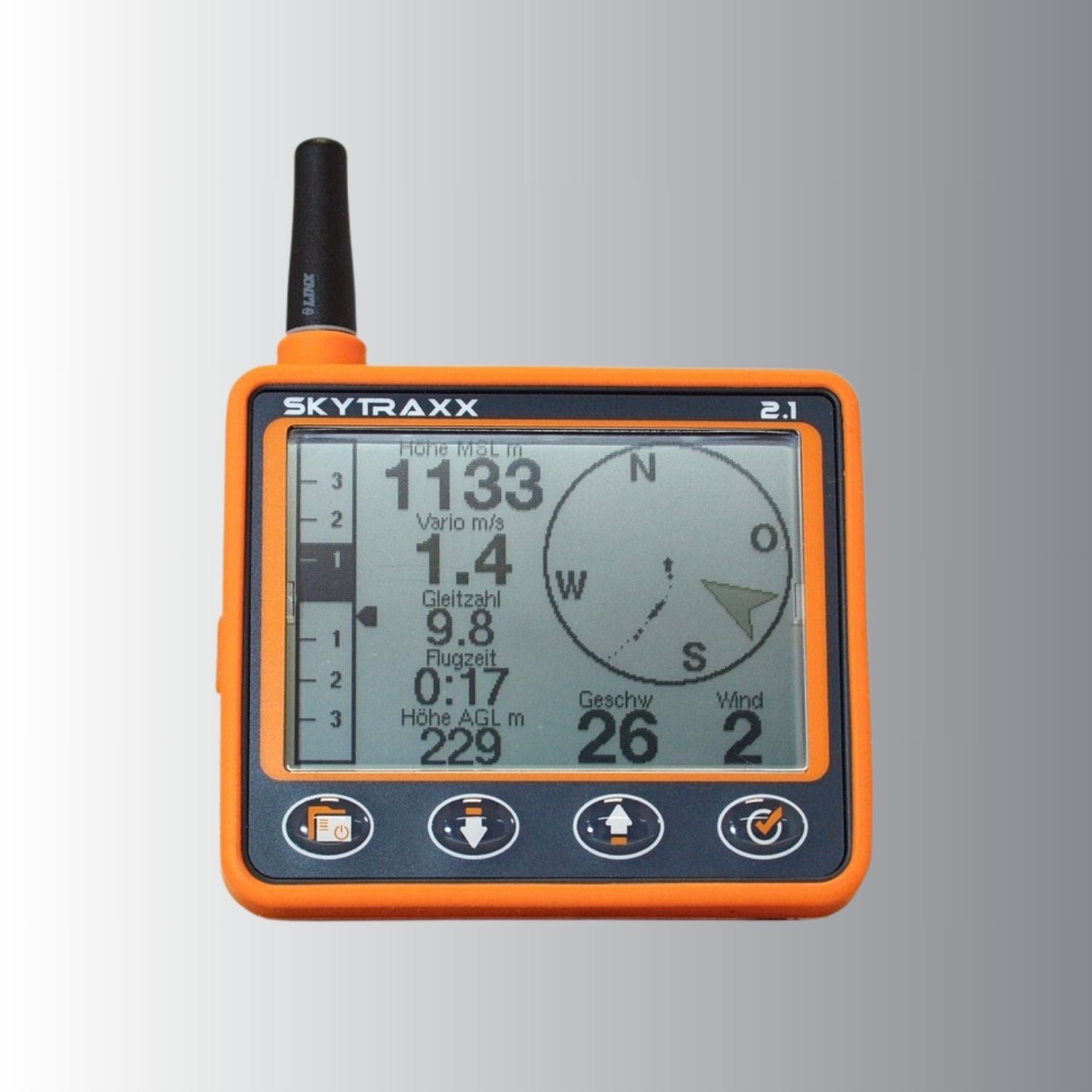
- Use apps and devices: Digital tools such as Burnair, XCTrack, or modern variometers such as Skytraxx 5 and 5 mini, XC Tracer Maxx II, or Air3 7.35+ help to avoid airspace violations.
- Know the VFR rules: Strictly adhere to visual flight conditions and minimum distances from clouds.
- Variometers:Devices with FLARM prevent collisions.
- Radio communications: An aircraft radio is often required for controlled airspace (C, D, E).
Best regards
,Your Paragliding24.ch team
We Love Paragliding ❤️