






















Paragliding Glossary from A to Z: Terms and Definitions for Pilots
The paragliding glossary from A to Z offers you a comprehensive collection of terms and definitions related to paragliding. Whether you are a beginner or an experienced pilot, here you will find everything you need to know to be better prepared and expand your knowledge.
The take-off weight is the total weight of the pilot including equipment and additional loads, including the glider, which must be taken into account during take-off.
A point on theterrain where warm air rises from the ground and forms a thermal bubble or tube. Common examples are forest edges, lake shores, or hillsides.
Descent aid
Descent aids enable pilots to lose altitude in a controlled manner. This is particularly necessary when the thermals are very strong and certain flight altitudes must be maintained. Or when sinking no longer occurs during normal flight due to strong thermals and a steady, unwanted climb takes place. Common methods include the B-stall, ear-flapping (small ears/big ears), the clapper spiral, and the spiral turn (steep spiral). These techniques reduce the sink rate by changing the aerodynamics of the canopy and are also used specifically to avoid turbulence or unwanted updrafts. Descent techniques are important and necessary skills for pilots and should be practiced regularly.
Acro flying
A discipline of aerobatics that includes challenging maneuvers such as SAT, wingover, or helicopter. These maneuvers require a lot of practice and an excellent feel for the canopy.
AGL (Above Ground Level)
Height above the ground, measured from the current location.
Active flying
In active flying, the pilot compensates for movements of the glider caused by turbulence or thermals. This is done by deliberately using the control lines and shifting weight.
Albedo
The ratio of reflected light to the amount of light incident on a surface. Surfaces with high albedo (e.g., snow) reflect a lot of light, which can influence thermal conditions.
AMSL (Above Mean Sea Level)
Height above mean sea level, a standard measure for flight altitudes.
The angle between the chord of the canopy profile and the oncoming air. Too large an angle leads to stall, while too small an
angle
causes the canopy to collapse.
A dimensionless value that describes the dynamic lift of a body surrounded by air.
Lift formula
The dynamic lift of a body can be calculated using four factors: FA = A (area of the body exposed to the airflow) * cA (lift coefficient) * ρ/2 (air density) * v2 (velocity).
An area in front of a slope or elevation where wind is deflected upward. This updraft enables soaring, provided it is strong enough to compensate for the sink of the glider.
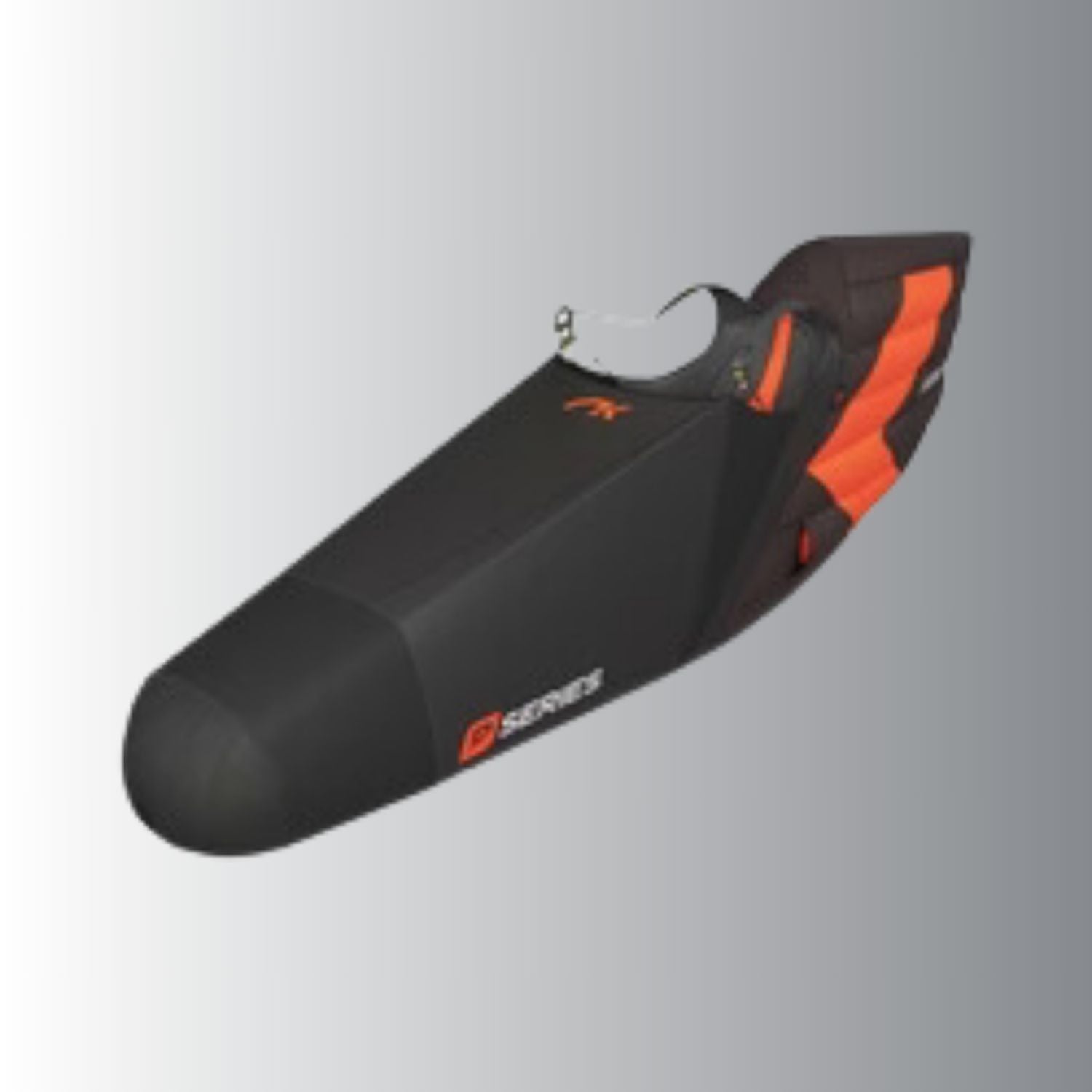
Acontainer that houses the rescue system. It is attached either directly to the harness or as a front container.
Barometric altitude formula
The barometric altitude formula can be used to describe the dependence of air pressure on altitude, i.e., the vertical distribution of air in the Earth's atmosphere. In the standard atmosphere (according to ICAO), the pressure at sea level is 1013.25 hPa. Every 5,500 meters, the air pressure is halved, i.e., it decreases by a factor of Decreases exponentially with altitude. At sea level, it can also be said that the air pressure decreases by 1 hPa every 8 meters of altitude, at approx. 5,000 meters it decreases by 1 hPa every 16 meters of altitude, and at approx. 10,000 meters it decreases by approx. 1 hPa every 32 meters of altitude.
B-stall
A descent aid in which the B-lines are pulled to deform the canopy. This drastically reduces speed and ensures a controlled descent.
Acceleration system
The acceleration system consists of a pulley on the risers of the paraglider and a foot accelerator, which are connected to each other. When the pilot activates the system with their feet, the angle of attack of the glider decreases, as the A and B lines in particular are pulled down. This causes the paraglider to fly faster (than at trim speed).
Bernoulli effect
According to Bernoulli, air pressure decreases in areas of fast or faster air flow.
Best glide
In the best glide, a paraglider flies as far as possible in calm winds. For most models, the best glide is in the trim speed range, i.e., the pilot releases the brakes up to the pulleys and does not brake the canopy.
Bezometer
A device for measuring the tear strength of the canopy fabric.
Blue thermals
Blue thermals describe thermal activity without cloud formation. The temperatures of the rising air and the ambient air are equalized before the condensation level is reached.
Gusty wind
Gusty wind is wind with strongly varying wind speeds.
CTR (Control Zone)
Control zones around airports. They extend from the ground to a specified upper limit and are only accessible for VFR flight with ATC clearance.
Pressure point
The point on the canopy where all the forces of the airflow converge. In stationary straight flight, it is located in the front third of the center of the canopy.
FL
The flight level (FL) refers to an area of equal air pressure or a specific altitude above standard pressure.
Front container
The front container is an external container for the rescue parachute, which is attached separately between the two harness carabiners. It is mainly used for harnesses that do not have an integrated external container due to their design.
Full stall
A full stall is a bilateral stall in which the air in the canopy escapes from the rear to the front. The angle of attack is too large, so that the airflow can no longer flow smoothly and the lift collapses.
G-force (cornering weight)
G-force is the combination of weight and centrifugal force acting on the pilot during turns. It is perceived as additional "weight," depending on the bank angle and speed. For example, in a 60° turn, twice the normal body weight (2g) acts on the pilot.
Minimum sink
Minimum sink refers to the brake setting at which the paraglider flies for the longest possible time in calm air. For most models, this means a brake line pull of around 15% and a control pressure of just under 2 kg.
Speed polar
A speed polar shows the sink rate of the paraglider (in m/s) in relation to the airspeed (in km/h) at different brake and acceleration positions. The pilot can use this to determine the glide performance of the wing. at different speeds and wind conditions.
Yaw
Yawing refers to the movement of the paraglider or aircraft around its vertical axis.
Glide path
The glide path describes the flight path of the paraglider through the airspace. In ideally calm air masses, the inclination of the glide path varies due to different brake and accelerator positions.
Paraglider
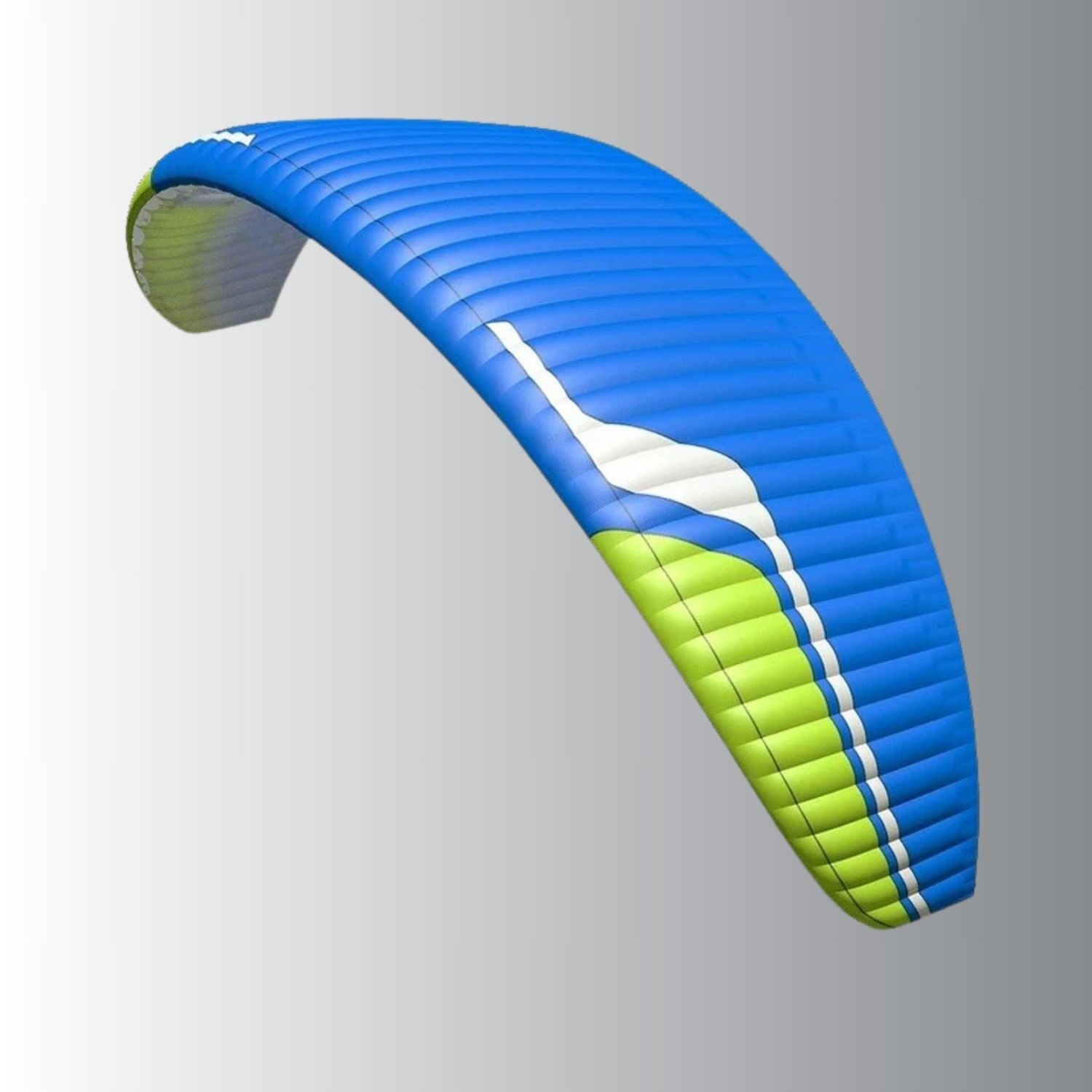
also: paraglider – gliding sail, consisting of a canopy and lines."Paraglider,"also known as a gliding sail or canopy, is the German term for paraglider and refers to an air sports device consisting of a canopy, lines, and harness.
Glide ratio
The ratio of distance traveled to altitude lost. It indicates how far a paraglider can glide in calm air.
Glide angle
The glide angle is the angle between the glide path of the canopy and the horizon.
Glide ratio
The glide ratio is the ratio of the lift of the canopy to the total drag, the ratio of the distance traveled to the altitude lost in a given period of time, and the ratio of the airspeed (in m/s) to the sink rate (in m/s).
Harness
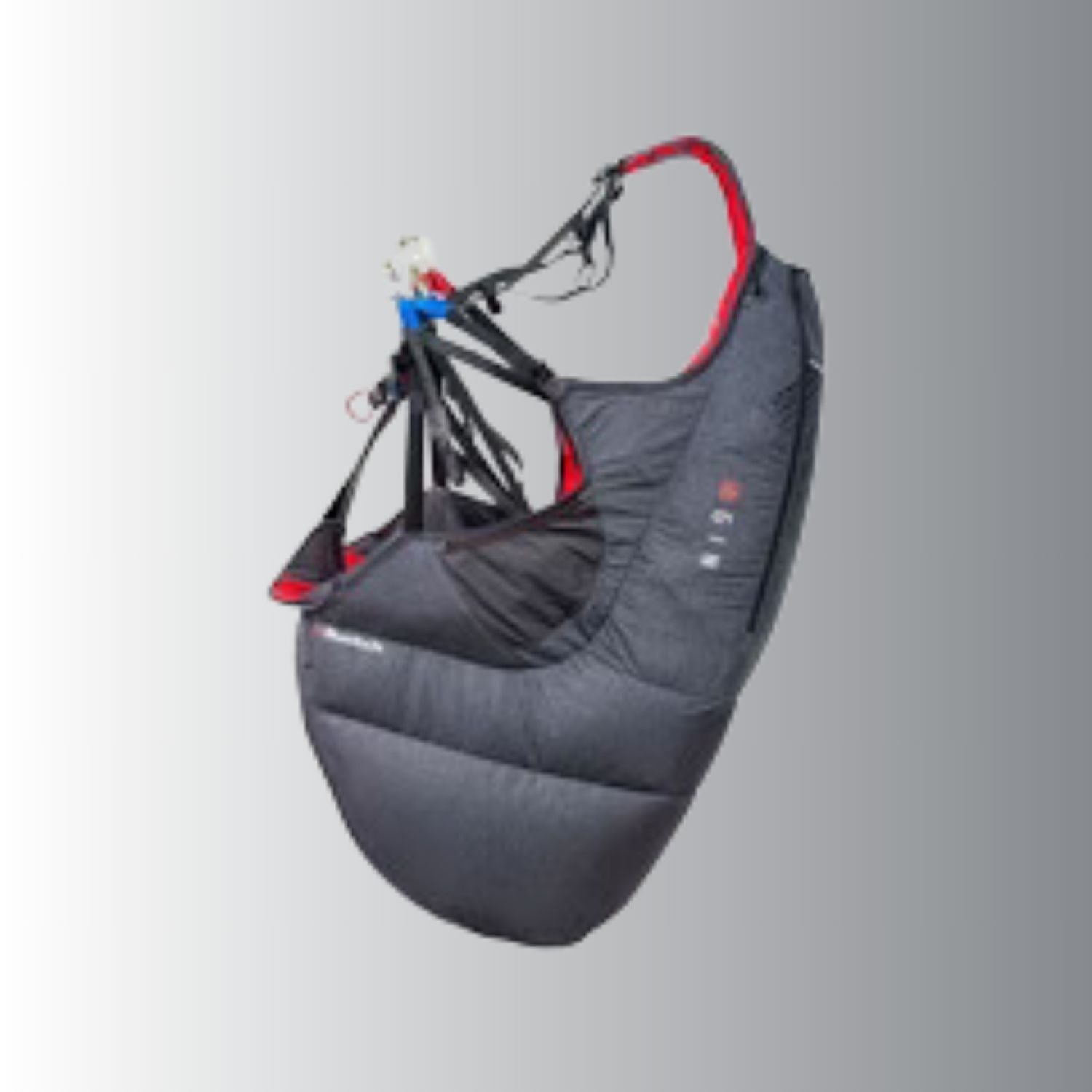
The harness is the pilot's seat and connects them to the paraglider. It provides comfort and safety and often includes a rescue system.
Hang glider
A hang glider is a type of flying kite. Unlike a paraglider, a hang glider consists of a rigid tubular structure covered with a sail. The pilot takes off and lands on foot and lies in a reclining position under the hang glider during flight.
ICAO chart
ICAO charts are aeronautical charts on which the airspace structure is depicted in accordance with the guidelines of the International Civil Aviation Organization (ICAO).
Induced drag
Induced drag in paragliding is a compensatory airflow in the stable area from the lower to the upper wing. It therefore only takes effect when, according to Bernoulli's principle, lift is applied to the profile, creating pressure differences between the upper and lower wings (upper wing: negative pressure, lower wing: positive pressure). As the paraglider moves through the air mass, the resulting vortex detaches from the profile and continues as a wake vortex.
Inner container
A container that houses the rescue system. It is attached directly to the side (left or right), usually on the right, of the harness.
IPPI Card
The IPPI Card is an international flight certificate that can be issued by the respective association for a fee and is valid almost worldwide in conjunction with the national license. The IPPI Card divides flying skills into five levels, known as ParaProcStages.
Flutter
During a collapse, part of the paraglider canopy collapses. The angle of attack is too small, so that the air does not hit the profile from below at the front, but from above – this is also referred to as negative airflow on the profile. In the affected area, the air in the canopy escapes completely or only partially, and the flexible paraglider fabric cuts under the part of the paraglider that is still airworthy. In many paraglider models, a collapse usually opens up on its own after a short time without any intervention.
Controlled airspace
Airspace in which flight movements are monitored by air traffic controllers.
Curve weight (g-force)
The combined effect of weight and centrifugal force during curved flight. The pilot perceives this additional load as g-force.
Laminar wind
Laminar wind is a wind with consistent wind speeds, i.e., a wind that is not interspersed with gusts.
Landing beer ;-)
Even though you are alone in the air as a paraglider pilot, paragliding is still a community sport. Paragliders are usually sociable people. For most of them, a landing beer together at the end of a beautiful day of flying is simply part of the experience!
Longitudinal axis
The longitudinal axis is a virtual line that runs lengthwise to the maximum extension of the canopy. In paragliding, it also represents the mirror or symmetry axis. It runs at right angles to the transverse and vertical axes.
Lee
The lee is the side of an object facing away from the wind. When flying, the lee is characterized by turbulent and sinking air masses.
Dead travel
The empty travel is the first approx. 10 centimeters of the control travel (starting from the pulley) in which the pilot pulls the brakes down, but the rear edge of the canopy does not yet deform. It merely tensions the brake lines.
Windward
The windward side is the side of an object facing the wind. It is characterized by calmer air masses.
MSL
Mean Sea Level (MSL) refers to the average sea level (NN).
Ear tuck
Ear laying is a descent aid that pilots can use to descend more quickly with their paraglider. To do this, the pilot pulls the outer sides of the canopy using the outer A-lines. Unlike other descent aids, the glider remains controllable via weight shift and maintains a horizontal speed.
Landing point
The reference point is an imaginary or visible point on a landing field that the pilot uses as a guide to land close to the target.
Pilot license
The pilot license allows you to fly freely in accordance with the regulations of the FOCA and Swiss flight rules. In combination with the international IPPI card, it is recognized almost worldwide and is valid indefinitely. In Germany, it is known as an "A license," and in Austria as a "paragliding license." It is the goal of the mandatory basic training for paraglider pilots.
Porosimeter
A porosimeter is a measuring device that tests the air permeability of paraglider fabric. This is important for evaluating the quality of the glider and its lift.
Profile resistance
Profile drag is created directly at the paraglider canopy, which generates lift.
QFE
QFE can be used to determine the altitude above an airfield. It indicates the current air pressure at airfield level. A useful mnemonic is: Question Field Elevation.
QNH
The QNH can be used to determine the altitude above mean sea level. It indicates the current air pressure at sea level. As a mnemonic, you can remember: Question Normal Height.
Rescue system
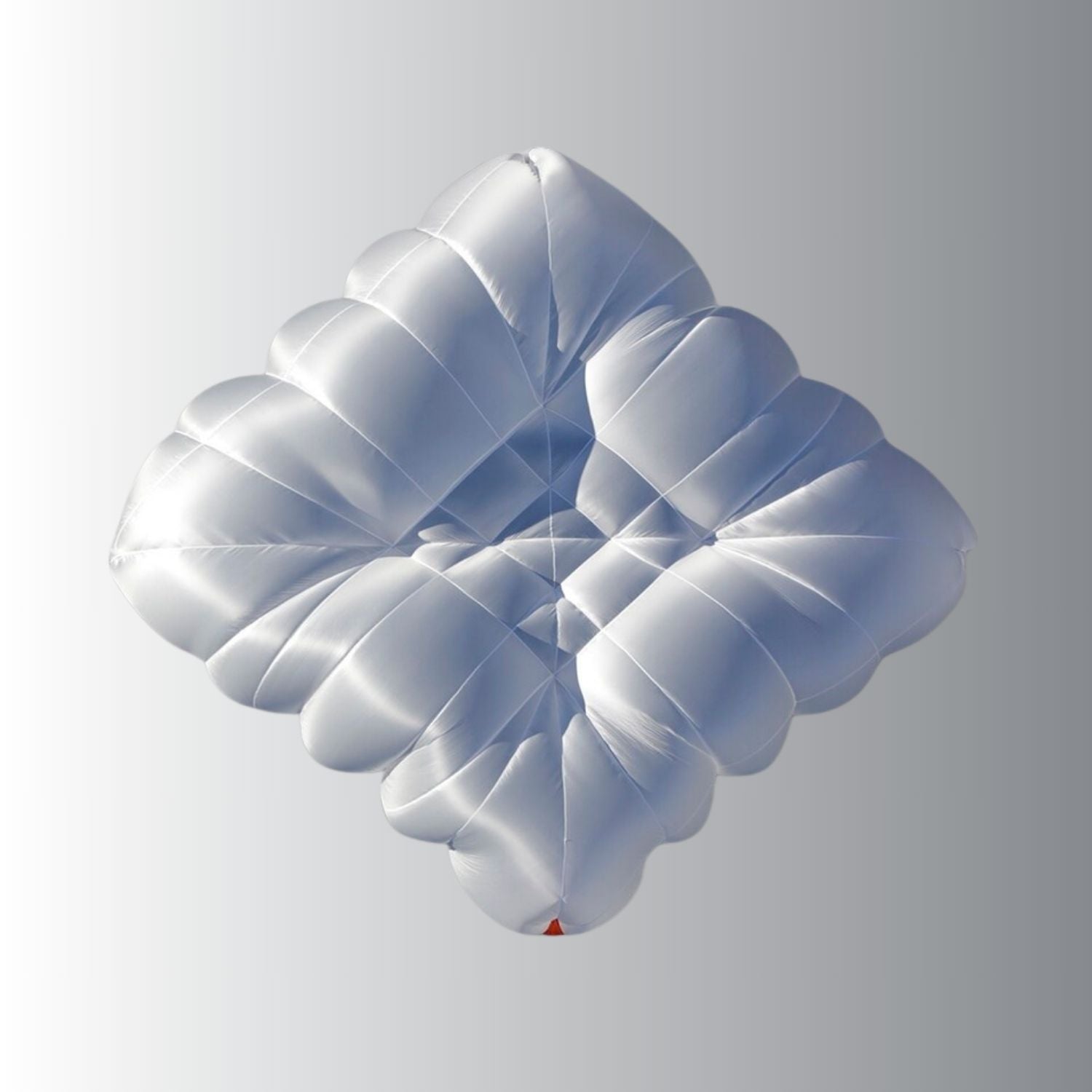
An additional parachute - also Rescue parachute Also known as a, or emergency parachute, which can be deployed by the pilot in an emergency to ensure a safe landing.
Rescue cord
The rescue cord is a 30 m long braided nylon cord with a 30 g lead weight attached to the end. After a tree landing, it is used to pull up rescue equipment for the pilot.
Stall
In a sack flight, the paraglider canopy, which is still filled with air, moves vertically downward. The dynamic lift collapses. Only drag acts on the paraglider, causing it to sink at a rate of approximately 4 m/s.
SAT
In an SAT turn, the center of rotation shifts between the paraglider canopy and the pilot, causing the pilot to fly backwards.
Takeoff weight
The take-off weight is also the departure weight, which consists of the pilot's weight, the weight of all equipment, including the glider, and all other items that the pilot takes with them when flying.
Dynamic pressure
Dynamic pressure is the dynamic pressure and corresponds to the increase in pressure at the point of impact of a body surrounded by airflow compared to the static pressure of the air. Dynamic pressure can be used to determine the speed relative to the air.
Stagnation point
The stagnation point is the point on the surface of a body (profile) that is exposed to airflow where the air theoretically hits perpendicularly. The speed of the flowing medium is zero.
Control pressure
Control pressure is the pressure or force that the pilot feels when pulling the control lines. It increases as the angle of attack of the canopy increases.
Stall
During a stall, the airflow can no longer flow along the paraglider profile because the angle of attack is too great. The dynamic lift collapses and, as a result, the internal pressure of the canopy collapses – the air escapes from the front to the rear. The pilot feels high control pressure in the high angle of attack range. At the moment of the stall, this pressure suddenly drops.
SHV (Swiss Hang Gliding Association)
The SHV is the central organization for paraglider and hang glider pilots in Switzerland. It represents the interests of pilots at national and international level and ensures compliance with and further development of safety and training standards.
TMA (Terminal Control Area)
Controlled area around large airports (e.g., Zurich, Geneva). Paraglider pilots should avoid these regions or obtain permission in advance.
Thermals
Rising air masses created by solar radiation and heating of the air. These enable long flights and altitude gain.
Trim speed
The speed at which a paraglider flies in a neutral control position. It is usually optimal for long distances.
Uncontrolled airspace
Areas where there is no air traffic control and visual flight rules apply.
VFR (Visual Flight Rules)
Visual flight rules under which paraglider pilots fly.
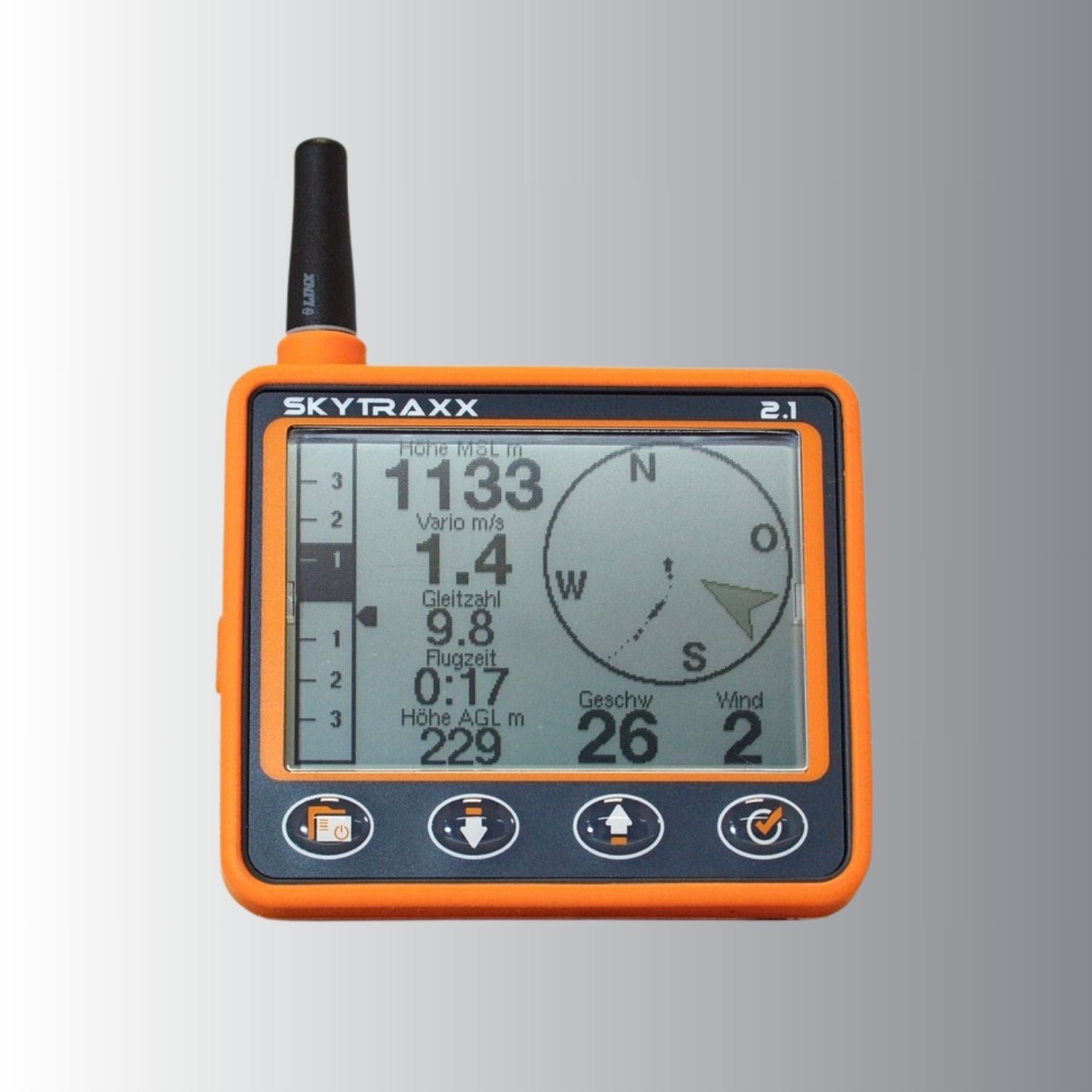
Variometer (Vario)
A variometer is a device for measuring ascent or descent. Modern variometers often have GPS functions. Thermal assistants, altimeters, live wind values, navigation, airspace maps, flight data storage, and much more.
VMC
VMC (Visual Meteorological Conditions) define the visibility conditions or meteorological conditions that must be present in order to fly under VFR.
Heading angle
The angle of attack is the angle between the heading and the actual course flown over ground.
Drag formula
The drag of a body can be calculated using four factors: FW = A (area of the body exposed to the airflow) * cW (drag coefficient) * ρ/2 (air density) * v2 (speed).
Winch, winch tow
One way to get airborne with a paraglider in flat terrain is to use a winch launch. The pilot is pulled into the air by a special winch, where they release themselves at an altitude of several hundred meters and can then search for thermals.
Wingover
Wingovers are rolling movements with an angle of more than 90°. Viewed from the ground, the pilot is above the paraglider canopy.
XC
The abbreviation stands for "cross country," which refers to distance flying.
Centrifugal force
Centrifugal force is a force that occurs during rotational and circular movements and is directed radially outwards from the axis of rotation.
The fascination of paragliding
Paragliding combines the joy of flying with a unique closeness to nature. From choosing the right equipment to analyzing weather conditions to the technical intricacies of flight, this sport requires dedication and continuous training. With thorough preparation and in-depth knowledge, you can take off safely and enjoy the freedom of the sky to the fullest.
Best regards
,Your Paragliding24.ch team
We Love Paragliding ❤️


