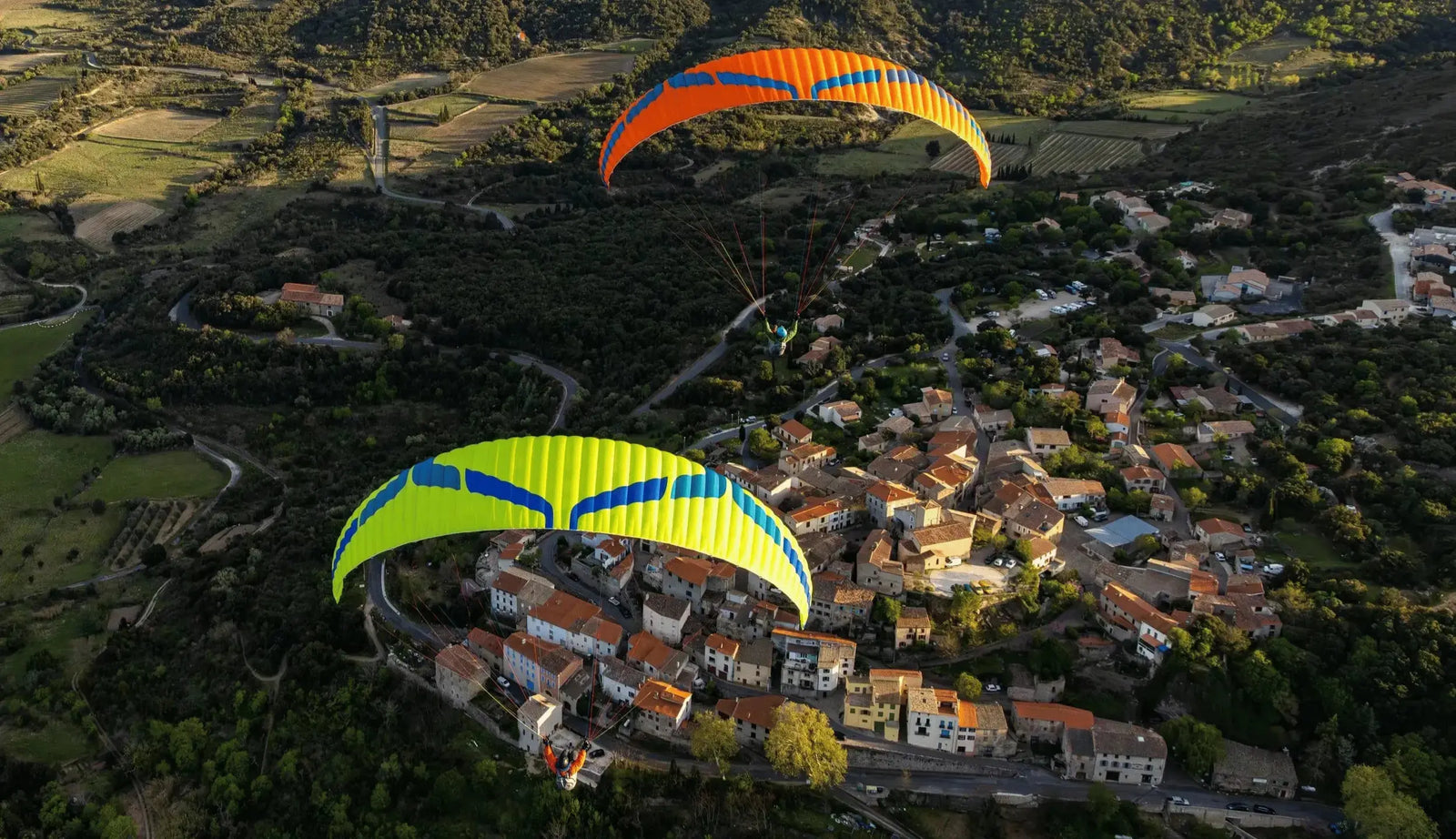




Cross-country flying is one of the most exciting aspects of paragliding. Covering long distances, making efficient use of thermals, and gliding silently through the air—it's a feeling of freedom that many of us love.
But how can you get better at it ? Here are some practical tips on how to improve your technique, focus, and confidence in the air—straight from the field for your next flight.
10 tips for cross-country flying: How can I improve my cross-country flying skills?
1. Set yourself a clear goal
Simply flying off rarely leads to real progress. As soon as you set yourself a specific goal – be it an FAI triangle, a certain distance or an exciting turning point – your flight automatically becomes more focused.
💡Tip: Plan your flight in advance with your favorite app. This will help you visualize the route and navigate better during the flight.
2. Learn to read the terrain
Thermals don't just happen by chance. Shadows, wind, and sunlight show you where there is energy in the air. Make conscious use of terrain features such as ridges and slopes and develop a feel for thermal conditions.
💡Tip: Take a few minutes before takeoff to observe: Where might there be lift today?
3. Hone your technique
Thermal flying is a craft. If you can center updrafts well, you'll fly further – that's a fact.
A little trick:Flysidewaysinto the thermal, then turn sharply in the other direction, wait 3 seconds or until the vario beeps less, then turn back in. This will often help you find the core(video).
💡Tip: Practice specifically—e.g., 5 minutes of clean centering — and then analyze your route. That way, you'll learn from every flight.
Varios such as the XC Tracer Maxx 2 and XC Tracer Maxx 3 or the Skytraxx 5 and Skytraxx 5 mini have a perfect thermal assistant tohelp you with this.
4. Patience will get you further
No Every day is epic. But every flight brings experience. Sometimes it's worth circling a few more meters in weak thermals instead of moving on too early.
💡Tip: If you're unsure whether to continue gliding or circling, opt for circling. Altitude is your best friend!
5. Use the gliding phases wisely
Too slow? Time lost. Too fast? Altitude wasted. The trick is to find the optimal speed. Your flight instrument shows you how efficient you are with the glide ratio – watch it and find the sweet spot.
💡Tip: Reduce your air resistance by putting your hands behind the risers – a simple trick with a noticeable effect!
6. Analyze your flights – and talk about them
After the flight is before progress. Tools such as XCTrack, Burnair, or XContest help you understand the flight. Even better: exchange ideas with other pilots – this broadens your horizons.
💡Tip: View your flight in a 3D model and reflect on your flight and the decisions you made. Where did you make good decisions and where did you make bad ones? Where were the thermals strong and why? Reflect on your flight based on the sun's position (Sonnenverlauf.de) at the given flight times, the prevailing wind (Windy.com), the terrain, your flight route (ThermXC), where you centered the thermals well and spun them out to the end, and where you didn't – and why not!
7. Clouds are friends – but treat them with respect
Clouds often provide good updrafts. If you avoid them altogether, you'll miss out on opportunities. The key is to fly with a cool head and always have a plan B.
💡Tip: Make sure that the edge of the cloud is at least 45 degrees above the horizon – that way you'll stay on the safe side.
8. Build up your flying endurance
Long flights are demanding on your body. Take snacks with you, drink regularly, breathe calmly – especially in stressful moments. Over time, your mental and physical resilience will grow. Mental training is the key to flying calmly and successfully. The book Aufwind im Kopf
(Upwind in Your Head)gives you step-by-step instructions and helps you become mentally strong.
💡Tip: If you feel nauseous when flying, ginger tablets and slow, deep breathing often help.
9. Fly with the equipment and settings that suit you!
Your equipment should support you, not stress you out. The right wing, the right harness —it makes a huge difference to your comfort and confidence.
If you are new to cross-country flying, wings such as the Niviuk Hook 6, Hook 6P or the Ikuma 3 or Ikuma 3 P are excellent choices. They combine solid performance with high safety and are easy to fly. Harnesses such as the Niviuk Konvers 3 with seat board for an open, direct flying experience or the NiviukHawk are ideal for getting started in the world of pod harnesses.
💡Tip: Make sure your take-off weight is correct and adjust your harness properly. This will allow you to fly more relaxed – and further. For perfect adjustment at home, we recommend our harness frame and our harness suspension.
10. Fly with an experienced pilot as your buddy and learn
An experienced paraglider pilot asyour buddy can greatly accelerate your personal progress – on several levels! A buddy sees what you do in flight – and can give you good feedback right after. This helps you improve your technique faster
.Experienced pilots know typical XC situations from their own experience. They can explain why they chose a certain course or thermal at a certain point – this helps you to think tactically.
💡Tip:It's more funinpairs – and you push each other to fly longer or more courageously.
In short... an experienced pilot by your side is like a flying coach.
Conclusion
Cross-country flying is much more than just thermals and technique. It's about planning, observation, inner calm – and the willingness to see every flight as a learning experience.
Stay tuned. Fly safely. And enjoy every kilometer. The sky is yours!
Your Paragliding24.ch team
We Love Paragliding ❤️